How to trade meme coins with a $10 portfolio in 2026 without fees eating the profit
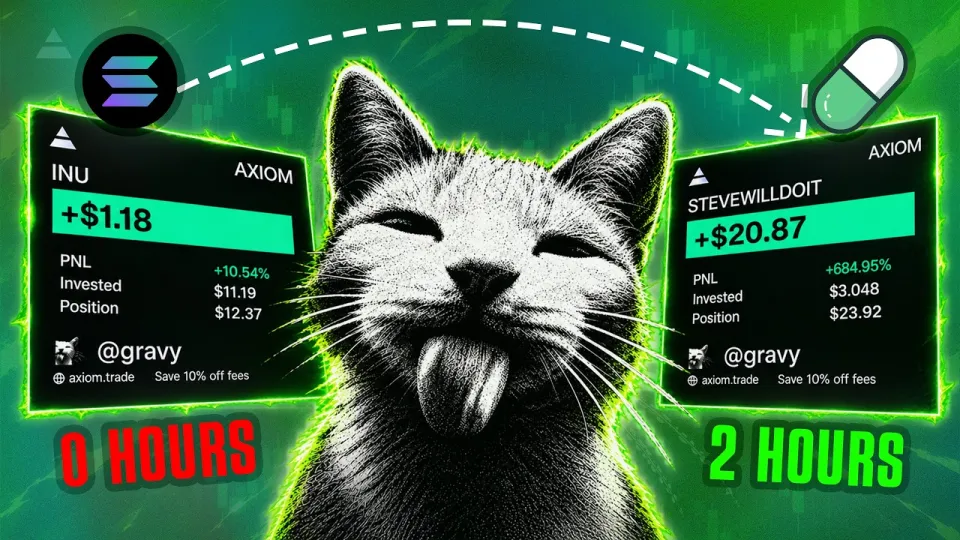
Video: I Tried Trading Memecoins with Just $10
You can order the same kind of articles for your own video to boost it on YouTube and Google. Just message the Telegram bot @sat_sit_bot. Articles with your video embedded are written and posted by the bot itself — on popular topical sites (no ads). Free trial — 50 articles.
Key takeaways
- Five real trades on Solana, each buy under 0.05 SOL — roughly $10 at SOL prices in late 2026.
- Tickers covered: STEVEWILLDOIT, NPC, MET (Meteora), PUMPY the Trader and UNTXD.
- The X Money coin meta is tied to the e/acc and Cream narrative cycle, not to a product launch.
- Axiom referral link offers 2x cashback and 15% lower fees, which matters most on small tickets.
- One trade was fumbled badly; the creator asks viewers whether to live trade from 0.1 SOL or 1 SOL.
You can trade meme coins with a $10 portfolio, but only if you treat position sizing and fees as the strategy rather than an afterthought. In a five-trade experiment on Solana, every buy stayed under 0.05 SOL, and the point was not to get rich but to see whether small tickets survive routing costs, slippage and the usual rug risk. The trades were placed through Axiom, where the creator's referral gives 2x cashback and 15% lower fees — the single biggest lever when your whole account is the size of a coffee order.
What a $10 meme coin portfolio actually means on Solana
A $10 meme coin account is not a smaller version of a $10,000 account; it is a different game with different math. On Solana, a swap typically costs a fraction of a cent in network fees, but the real cost sits in the pool: liquidity depth, price impact and the spread between what you pay and what you can sell into. On a thin pump.fun-style launch, a $10 market buy can move the price enough that you start the trade down several percent before the chart even prints.
The practical rules that follow from that math:
- Cap each buy at 0.05 SOL or less so a total loss never removes more than a slice of the account.
- Check the pool's liquidity before entry — if your order is a meaningful share of it, you are the exit liquidity.
- Count the round trip, not the entry: buy fee, sell fee, priority fee and slippage all hit twice.
- Assume at least one position goes to zero; with five trades, that is the realistic base case, not bad luck.
The experiment's answer to the original question is therefore conditional: small-portfolio meme coin trading is possible, but the edge comes from narrative selection and fast exits, not from the size of the bet.
The five trades and the narratives behind them
The five trades in the video — STEVEWILLDOIT, NPC, MET, PUMPY the Trader and UNTXD — were all narrative plays rather than chart plays. That is the core lesson: on Solana meme coins, the ticker is a story wrapper, and the story decides whether anyone buys after you.
- STEVEWILLDOIT is a classic "reply guy" meme built around a character promising to do something; its value comes from how widely the joke travels on X.
- NPC plays on the non-player-character meme, a format that resurfaces whenever the timeline jokes about people following scripts instead of thinking.
- MET (Meteora) leans on a real Solana protocol name, which gives the ticker instant recognition and, equally, instant confusion risk with the actual product.
- PUMPY the Trader is a meta-meme about trading itself — the kind of self-referential joke that spreads fastest among people already in the trenches.
- UNTXD is a low-effort, high-recognition ticker in the same family; these names live and die on whether the joke lands within hours.
What unites them is timing. A narrative coin is only tradeable while the joke is still climbing; once the timeline has seen it a hundred times, the marginal buyer is gone and the chart becomes a slow bleed. The creator's own framing — why he bought, why he sold — matters more than the tickers, because the same names will be cold by the time anyone reads this.
Why the X Money coin meta ran
The X Money coin cycle was a narrative trade on a rumoured product, amplified by a community that already believed in the underlying thesis. The video ties the run to the e/acc and Cream crowd — the accelerationist corner of crypto Twitter that reliably front-runs anything connected to payments on X. When a rumour touches a platform with that much distribution and a subculture willing to bid it, the resulting coin is less an investment than a coordination game.
That pattern is worth memorising because it repeats. A meta usually needs three ingredients: a recognisable name, a credible catalyst (a real product, a real person, a real rumour), and a group with a shared identity that will shill it for free. X Money had all three. The risk is symmetrical: when the catalyst fails to materialise, the same crowd exits in minutes, and small accounts that bought the top have nobody to sell to.
Position sizing, fees and the trades that go wrong
Fee discipline is the difference between a small portfolio that survives and one that quietly evaporates. A 1% round-trip cost on a $10 account sounds trivial until you take five trades and lose a fifth of the account to friction alone. Axiom's referral terms — 2x cashback and 15% less in fees — are pitched at exactly this problem, and on micro tickets that discount is proportionally larger than it looks.
Sizing rules that held up across the five trades:
- Never let one entry exceed 0.05 SOL, so a rug costs a fraction of the account.
- Take partial profit on the first strong green candle instead of waiting for a double.
- Cut immediately when the narrative stops being discussed — not when the chart breaks support.
- Keep a cash buffer so a single bad fill does not end the session.
One of the five trades was fumbled badly, and that is the most instructive part of the experiment. Small accounts rarely die from one catastrophic bet; they die from hesitation — holding a dead narrative because selling at a 40% loss feels like admitting the thesis was wrong.
Common questions from small-portfolio traders
The most frequent doubts around low-balance meme coin trading are about consistency, not capital. Viewers of the experiment asked how the creator keeps finding coins with strong narratives while the timeline feels overwhelming, and why their own buys seem to mark the top. The honest answer is that narrative discovery is a filtering problem: most people follow too many accounts and end up buying whatever is loudest at the moment they look.
A workable filter looks like this:
- Follow a small set of accounts that consistently post early, not the ones that post most.
- Track which communities repeat — the same shillers rotating into a new ticker is a signal about the meta, not the coin.
- Write down the thesis in one sentence before buying; if you cannot, you are the exit liquidity.
- Accept that selling 20–40% down and watching the coin recover is a normal cost of discipline, not proof you were wrong.
Another recurring question was about the final portfolio value. The video does not close with a total PnL figure, which is itself a useful reminder: with five sub-0.05 SOL trades, the absolute result is small either way. The transferable output is the process — sizing, narrative timing, and the willingness to exit.
Useful links from the experiment
- Axiom trading terminal with 2x cashback and 15% lower fees — the platform used for all five trades.
- https://discord.gg/W7TqkExcSd — The Trenches Discord community.
- https://discord.gg/9W5j3XUgYB — Discord with free Axiom imports and trade signals (not financial advice).
- https://x.com/gravyski — the creator's X account.
- https://www.bitbase.com/landing-page/trading-earning-Gra?ref=8CYOGY — leverage trading with a 20% reduction on futures fees.
Bottom line
Trading meme coins with $10 is possible, but the experiment shows the constraint is discipline rather than capital: sub-0.05 SOL entries, fast exits and a narrative filter matter more than the size of the account. Fees and slippage are the real opponent on micro tickets, which is why a fee discount or cashback referral changes the math more than any single pick. The five trades — STEVEWILLDOIT, NPC, MET, PUMPY and UNTXD — are less a watchlist than a demonstration of how quickly a joke stops paying. The creator, the gravy channel, frames it honestly: one trade was fumbled, and the next step is a live session starting from 0.1 SOL or 1 SOL. If you want to replicate the setup, start with the same terminal via Axiom and keep the first position small enough that being wrong is boring.
Source: I Tried Trading Memecoins with Just $10 · Markdown version
Questions & answers
Can you really trade meme coins with only $10?
Yes, technically — five trades under 0.05 SOL each were executed on Solana without the account being wiped out by fees. The catch is that $10 limits you to micro positions where slippage and spread take a proportionally larger bite, so the strategy has to be built around fast exits and narrative timing rather than holding for multiples.
How do fees affect a small meme coin portfolio?
Fees hit twice per trade — on entry and exit — plus priority fees and slippage, so a round trip can cost several percent of a $10 position. That is why referral terms such as 2x cashback and 15% lower fees matter disproportionately on micro tickets: they do not make you profitable, but they slow the bleed.
How do you find meme coins with strong narratives?
Filter rather than scroll: follow a small number of accounts that consistently post early, watch which communities rotate into new tickers, and write the thesis in one sentence before buying. If the joke is already everywhere on the timeline, the marginal buyer is gone and you are likely the exit liquidity.
Why do small traders sell at a 20–40% loss and then watch the coin run higher?
Because exits are usually triggered by price rather than by the narrative dying, and meme coins often bounce on noise after a flush. The fix is to define the exit condition before entry — either the story stops being discussed or a fixed loss level is hit — and to accept that some sold positions will recover without you.